


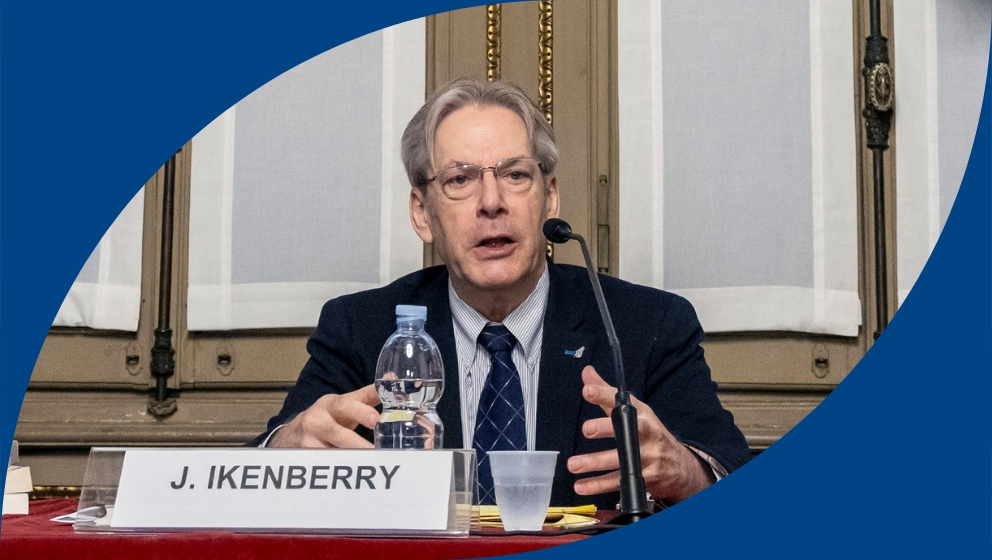
On the day of Donald Trump's inauguration in his second term, the ASERI School of Global Politics hosted the Global Politics after the US Elections conference, with the participation of G. John Ikenberry and Andrea Locatelli. The event was an opportunity to reflect on the new international balance and the implications of Trump's re-election for the global order. Director Damiano Palano emphasized Ikenberry's contribution to the theory of international relations, particularly with respect to the transformations of the liberal order, and his long-standing link with ASERI.
According to Ikenberry, Trump's re-election is not an anomaly, but a reflection of a deeper trend in American politics. He challenged the dominant interpretation that saw the 2016 election as a "distortion of the course of history," arguing instead that Trump embodies a trajectory rooted in U.S. politics. His transactional view of power and skepticism toward multilateralism are not mere temporary deviations, but indicators of the structural transformation of American hegemony. Trump's unpredictability and his strategy based on bad man theory make it difficult to anticipate his moves. Already in his first term, his decisions undermined the multilateral system, as demonstrated by the withdrawal from the Paris Agreement and the threats to NATO. Now, with congressional control and a favorable Supreme Court, his administration could take on an even more radical character, with disruptive effects on the international balance.
However, although Trump enjoys unprecedented freedom of action, institutional and political constraints could limit his most extreme moves. The concept of policy feedback, as Ikenberry explained, suggests that political and economic sustainability always requires a certain degree of realism. Even a president who defies conventions must ensure the stability of the system, avoiding actions that compromise its very conditions of power. However, the erosion of democratic institutions remains a source of instability, in the United States as well as globally. The delegitimization of the judiciary, the press and the electoral system – pursued by Trump in his first term – has weakened the traditional mechanisms of checks and balances. This strengthens its position in the short term, but risks backfiring, undermining its ability to govern and increasing political uncertainty.
The decline of the liberal order is accompanied by the emergence of a new global configuration, characterized by a tripolar system. According to Ikenberry, the competition between three blocs – the global West (the United States and Europe), the global East (China, Russia and allies) and the global South (the developing world) – will redefine the dynamics of international governance. American hegemony, which has guaranteed stability for over seventy years, appears increasingly fragile in the face of these transformations. The growing interdependence of global crises, from geopolitics to technology, amplifies the vulnerabilities of the international system. Ikenberry introduced the concept of polycrisis, emphasizing how climate change, pandemics, geopolitical tensions and technological revolution can no longer be addressed in isolation. The competition between the United States and China is no longer only economic and military, but also ideological and technological, with profound implications for the stability of the global order.
The future of the liberal order remains uncertain. Traditional multilateral institutions, from the G7 to the G20, appear less and less effective, while the United States seems reluctant to exercise a leadership role. However, according to Ikenberry, the fate of the international order is not yet sealed. If liberal democracies want to avoid complete fragmentation, they will have to redefine their cooperation strategies and strengthen their commitment to defending democratic principles. The global order is entering a phase of structural uncertainty, in which the rules of the past are no longer sufficient to guarantee stability and security. Trump's re-election could accelerate the disintegration of the multilateral system, but political and economic constraints could limit its most extreme effects. In any case, the international scenario is set to change, and the future of global relations will depend on the ability of international actors to adapt to new challenges.
Ikenberry outlines several possible scenarios for the future of the world order. One possibility is that the tripolar world will settle into a precarious equilibrium, in which no actor is able to assert clear dominance over the others. A second hypothesis is that, once the Trump presidency is over, the United States will attempt to revive its global leadership, even if this would require a greater commitment to the Global South. Finally, there is a risk that the absence of clear leadership will lead to a long period of fragmentation and conflict. In this perspective, the ability to offer a convincing narrative of the future becomes a crucial element. Global leadership will not only be defined by economic and military power, but also by the ability to propose a governance model and a vision of the world capable of attracting consensus.
Trump, however, could still hold surprises, given his transactional and unpredictable approach. Ikenberry points out that, although the president enjoys ample room for manoeuvre, there are structural limits that will affect his actions. The first is time: the mandate lasts four years, but the mid-term elections could already change the political context after two years. The second concerns the economy: protectionist policies and trade wars could have negative repercussions on the United States itself. The third is linked to strategic contradictions: Trump tries to reduce international commitments, but in doing so he risks alienating allies he continues to need.
In conclusion, the future of global politics remains marked by many uncertainties, not least because of the possibility of unforeseen events. Quoting Harold Macmillan's famous phrase – "Events, dear boy, events" – Ikenberry recalls that unexpected variables could redesign the international agenda in the coming years, giving rise to developments that are difficult to predict, even for the most unpredictable political actor.