


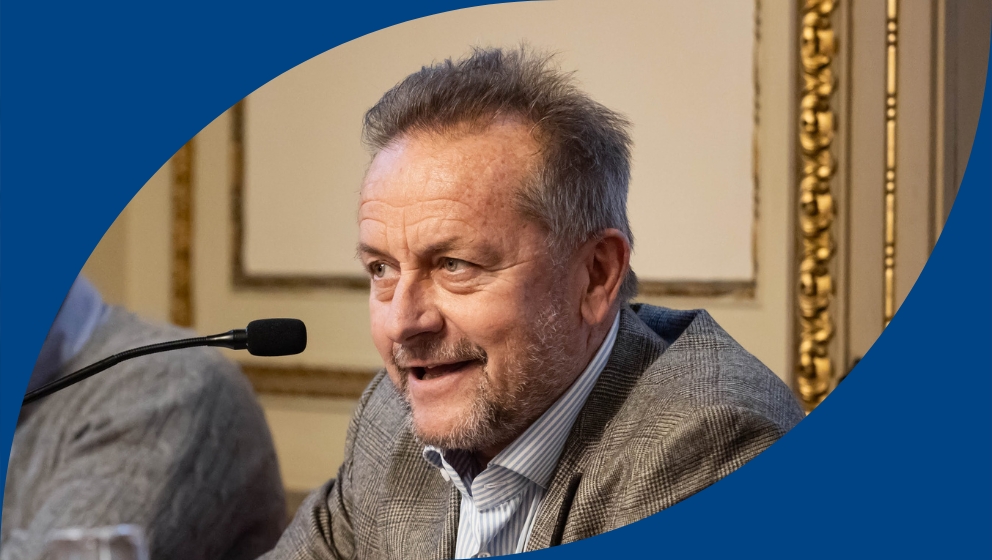
In the context of growing global tensions and the need for a deeper understanding of conflicts, ASERI organized a meeting with Lorenzo Cremonesi, special correspondent of Corriere della Sera, introduced by Vittorio Emanuele Parsi and moderated by Damiano Palano, director of ASERI. The event was part of the "Telling the war" review, dedicated to the narration of conflicts, with the aim of offering a critical reflection on war dynamics. Cremonesi's speech focused not only on the conflicts in Ukraine and Palestine, but also on the role of information in shaping public perception.
"War is not an exception but a constant in history," Cremonesi stressed, questioning the perception of a peaceful era after the Cold War. "After the end of the Cold War, we deluded ourselves that the era of wars was over," he observed, explaining how numerous latent conflicts had been removed from the Western public debate and then resurfaced in scenarios such as Ukraine and the Middle East. His direct experience in war zones has allowed him to highlight the long-term dynamics that precede any conflict, often ignored or underestimated by political decision-makers and public opinion.
The discussion addressed the return of a transactional view of power, with a focus on the potential impact of Donald Trump's re-election on the global order. "Trump's approach, skeptical of multilateralism, marks a break with the past," Cremonesi said. If the US leader were to question NATO and relations with European allies again, the continent's security would be greatly weakened. "If the United States ceases to be the guarantor of liberal democracies, what will be the fate of the international order?"
Modern warfare is characterized by an evolution in combat goals and methods. "The war in Ukraine was initially underestimated by the Ukrainians themselves," Cremonesi explained, pointing out how the West has struggled to understand the extent of the Russian invasion. "We weren't prepared to accept it, to understand it." His direct experience in war theaters has allowed him to grasp the importance of a timely response and the need for greater strategic awareness on the part of European nations.
A central theme of the discussion was the failure of traditional peace policies. "The Oslo Accords could have guaranteed lasting stability in the Middle East, but they have been undermined by the expansion of Israeli settlements and the rise of extremism," Cremonesi said. Similarly, the policy of appeasement towards Russia has not prevented the invasion of Ukraine; on the contrary, it has encouraged Moscow's imperial ambitions. "Like it or not, strength remains a fundamental element in international relations," he reiterated.
The debate also focused on the European Union's ability to develop a common foreign and defence policy. "Without the abolition of the right of veto in foreign and security policy, the EU will never become a credible geopolitical actor," Professor Parsi stressed. The only way to build a stronger and more cohesive Europe is through the creation of a common defence, supported by adequate investment in military capabilities. "Without a strong Europe, with a shared vision, we will always be a continent at the mercy of events."
Finally, the role of journalism in conflicts, especially in the face of disinformation, was analyzed. "War journalism must be on the ground; otherwise it risks being reduced to mere propaganda," Cremonesi said. In an era dominated by social media and fake news, direct presence in conflict zones remains essential to understand the complexity of wars. "Without journalists on the ground, the narrative of wars remains in the hands of governments and power groups."
The event sparked a lively debate among the participants, leaving a deep awareness: war is a reality we must deal with. Ignoring it or pretending that it does not concern us only postpones the choices necessary to face an increasingly unstable and fragmented world. "War is not a distant possibility: it is already here, and it is shaping our future."