


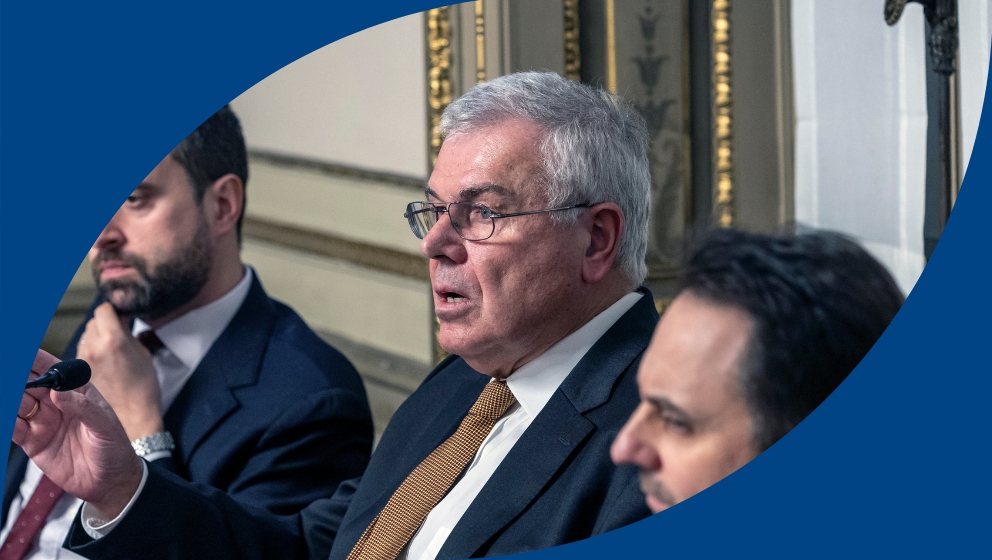
"We are living through the end of an era." With these words, Professor Ludger Kühnhardt opened his recent lecture at ASERI's School of Global Politics , emphasizing the precariousness of the current global order. We have entered a dangerous transition phase, in which the international system, which for decades has guaranteed stability, is now shaken by multiple crises: the return of war in Europe, the erosion of multilateralism, uncertainty about the role of the United States and the rise of new powers. In this context, Europe finds itself at a crossroads: adapt to this new reality or risk irrelevance.
For years, many believed that the liberal order established after 1945 was a solid and lasting structure. After the end of the Cold War, Western optimism led to the belief that globalization and the spread of democracy would usher in an era of peace and progress. But, as Kühnhardt observed, this was a "short-sighted" view. The world was never truly unipolar, and the rebalancing of global power was only a matter of time.
Europe has lived under the illusion that economic integration was sufficient to guarantee security and political influence. However, events such as the conflict in Ukraine and tensions with the United States during the Trump presidency have shown that the EU can no longer rely on the old paradigms. The crisis of the liberal order stems not only from external pressures, but also from the internal fragility of the West itself, where consensus on democratic values is eroding.
One of the most overlooked factors in Europe's decline is demographic change. As Kühnhardt illustrated, Europe's global weight is drastically decreasing: today the continent represents only 6% of the world's population and its share of global GDP has fallen to 14.5%. Ageing reduces the capacity to innovate and invest in the future, while regions such as Asia and Africa are experiencing exponential growth.
This demographic decline is not just a statistical but a political reality, influencing the way Europe faces global challenges. An 'older' continent tends to prioritise stability and conservation over change and risk, slowing down the EU's ability to react to geopolitical transformations. If Europe does not find a way to compensate for this disadvantage, it risks becoming increasingly marginal on the international stage.
Europe's response to recent crises has been slow and fragmented. Kühnhardt pointed out that the old method of functional integration – based on gradual and incremental steps – is no longer sufficient in a world where decisions must be quick and effective. The war in Ukraine has highlighted Europe's difficulties in responding in a unified way to security challenges, while the inability to develop a common industrial policy has left the EU vulnerable to technological competition with the United States and China.
Another major weakness is the absence of a truly integrated foreign and defence policy. Without credible deterrence capabilities, Europe remains dependent on the United States for its security, while actors such as Russia and China exploit its internal divisions. As Kühnhardt pointed out, the debate on strategic autonomy is still stuck between ambitious declarations and the reality of an EU unable to overcome national vetoes on crucial issues.
Despite these weaknesses, Kühnhardt does not consider Europe's decline inevitable. The EU still has room to reaffirm its role, but radical choices are needed. He outlined three key priorities for meeting the challenges of the new global order: first, accelerating political and strategic integration by removing the right of veto in foreign and security policy. This would allow for faster and more effective decisions, allowing the EU to act as an autonomous geopolitical actor. In parallel, investing in innovation and technology is essential to bridge the competitive gap with the United States and China, creating European champions in key sectors such as artificial intelligence, green energy and common defense. However, without reforming the economic governance model, these objectives risk remaining unattainable. The current system of strict fiscal rules and national budgets is no longer sustainable, necessitating the adoption of common investment instruments, including a permanent defence fund and a European industrial plan. These measures would reduce strategic dependence on external actors and ensure greater economic and geopolitical resilience for the EU.
Europe still has a window of opportunity to strengthen, but time is running out. The crisis of the liberal order is not a temporary anomaly but a structural change that requires rapid and decisive responses. Without leadership capable of facing this new reality, the EU risks being relegated to the margins of history.
As Kühnhardt said: "Transitions are always dangerous moments. Only those who know how to ask the right questions and make difficult decisions can survive these changes." Today, Europe is faced with this challenge: to stand firm and accept decline or to find the courage to finally become a global player.